

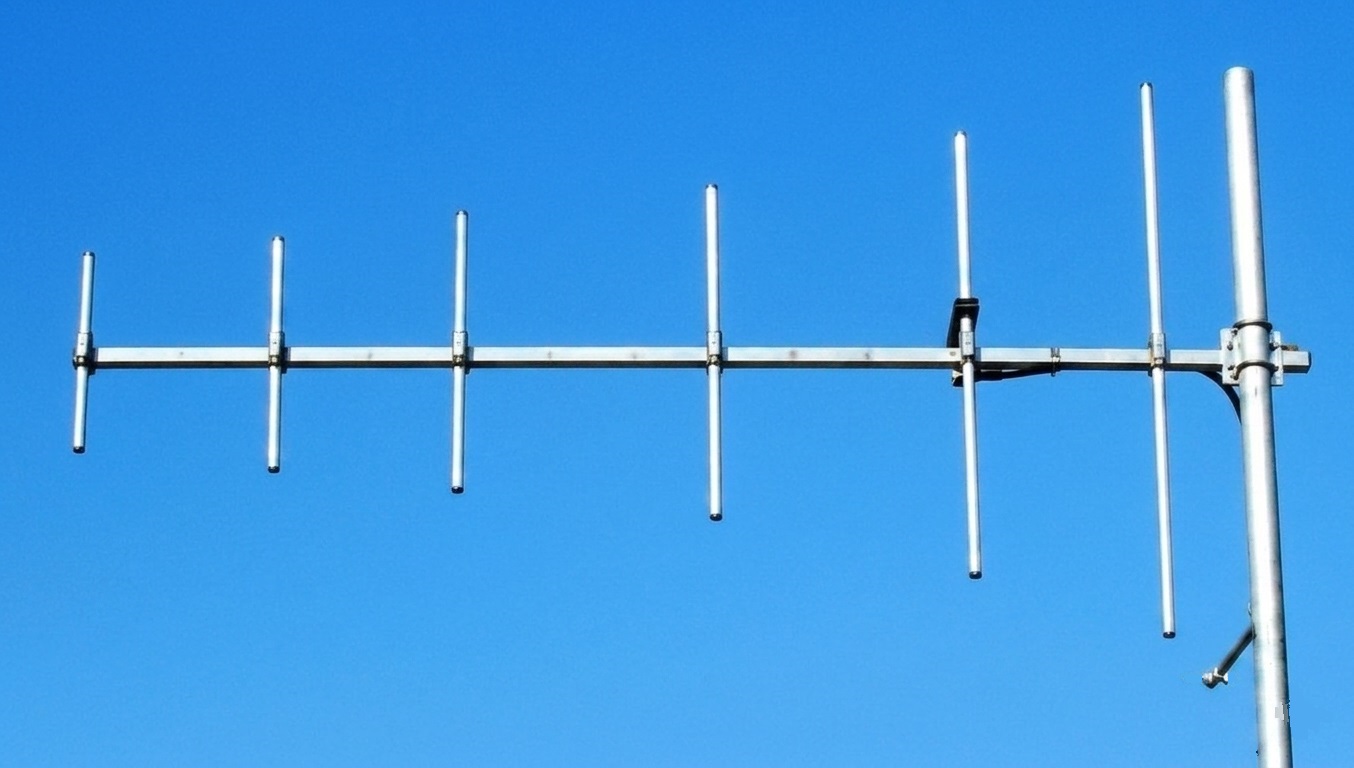
A Yagi antenna is a directional antenna that focuses radio energy in one direction, giving strong gain at a specific frequency band. If you need to link two fixed points over a long distance, or pick up a distant signal, a Yagi is one of the most widely used choices.
In this guide we explain how a Yagi antenna works, the main types, where Yagi antennas are used, and how to choose the right one for your link.
How does a Yagi antenna work?
A Yagi antenna (also called a Yagi-Uda antenna) is built from several metal elements mounted along a central boom. Each has a job:
- Driven element: the one connected to your cable. It sends or receives the signal.
- Reflector: a slightly longer element behind the driven element. It reflects energy forward.
- Directors: slightly shorter elements in front. They guide the signal and sharpen the beam.
The reflector and directors are not connected to the cable. They pick up energy from the driven element and re-radiate it so the waves add up in front of the antenna and cancel behind it. The result is a beam pointing along the boom.
Key features of a Yagi antenna
- Directional gain. It concentrates the signal toward one direction, which extends range and helps reject interference from other directions.
- More elements, more gain. Adding directors usually increases gain and narrows the beam.
- Narrower bandwidth. A Yagi works best around its design frequency. If you need to cover many frequencies, a wideband antenna is a better fit.
- Simple and robust. With no active parts, it is a reliable choice for outdoor links.
- Polarization by mounting. Mounting the elements vertically or horizontally sets the polarization, which must match the antenna at the other end of the link.
Where are Yagi antennas used?
- SCADA and telemetry links: connecting remote sites to a control centre. Our fiberglass radome Yagi UHF antenna is used in this kind of installation.
- Point-to-point data links: fixed wireless links between two sites over longer distances.
- Radio communication with remote stations: base station links where the other end is in a known direction.
- Long-distance reception: receiving weak signals from a distant transmitter.
- Defence and government communication: fixed directional links where range matters.
Types of Yagi antenna
We make three types of Yagi antenna:
- Yagi (single): the standard directional Yagi. We list 8 models for VHF and UHF, from 66 MHz up to 2550 MHz. VHF models ship with the elements removed and are assembled on site with simple hand tools. UHF models arrive pre-assembled, with the elements permanently riveted to the boom.
- Dual stacked Yagi: two Yagi antennas stacked and fed together through a phasing harness. The stacking distance is set at the factory for maximum gain, and the pair can be stacked horizontally or vertically to control beamwidth in the plane you need. It arrives pre-assembled.
- Yagi back-to-back: two Yagi antennas mounted back to back so one installation covers two opposite directions.
See the full range on our Yagi antenna page. Custom in-band and out-of-band versions are available on request.
Our Yagi models at a glance
| Type | Model | Frequency | Bandwidth | Gain |
| Yagi | SXY-7510 | 66 to 88 MHz | 5 MHz | 10 dBi |
| Yagi | SXY-15010 | 136 to 174 MHz | 8 MHz | 10 dBi |
| Yagi | SXY-45013 | 330 to 512 MHz | 20 MHz | 13 dBi |
| Yagi | SXY-85013 | 600 to 1250 MHz | 20 MHz | 13 dBi |
| Yagi | SXY-245013 | 2350 to 2550 MHz | 100 MHz | 13 dBi |
| Yagi, dual band | SDBY-918010 | 900 and 1800 MHz | 40 MHz | 10 dBi |
| Dual stacked | SDY-7513 | 66 to 88 MHz | 4 MHz | 13 dBi |
| Dual stacked | SDY-15016 | 136 to 174 MHz | 6 MHz | 15 dBi |
| Dual stacked | SDY-85016 | 800 to 990 MHz | 70 MHz | 16 dBi |
The SXY-45013 is also available in a version for the SCADA and TETRA bands, and the SXY(A)-80025 covers one GSM band in the 900/1800 MHz range. Ask us for the datasheet of any model.
How to choose a Yagi antenna
- Frequency band. A Yagi is built for a specific band, so match it to the frequencies your radios use. See the table above.
- Gain and beamwidth. More gain means a longer reach but a narrower beam, so aim becomes more important. A dual stacked Yagi gives more gain than a single Yagi of the same band.
- Polarization. Match the antenna at the other end of the link, vertical to vertical or horizontal to horizontal. Our mounting hardware supports both.
- Weather and mounting. For outdoor sites, check the construction and the pipe or mast you will fit it to. A fiberglass radome protects the elements from the weather.
- Connector and cable. Our Yagi antennas use an N-female connector, so choose a low-loss cable and adaptors that match your radio.
Limits of a Yagi antenna
A Yagi gives strong gain in one direction, but it has trade-offs:
- It works over a narrow band. If you need many frequencies, use a log periodic dipole antenna, which gives directional gain across a wide band.
- It must be aimed. If you do not know the signal's direction, or need all-round coverage, use a discone antenna.
- A narrow beam means small aiming errors reduce the signal.
Installation tips
- Point the antenna toward the other site with a clear line of sight, free of trees and buildings.
- Mount it high, and keep it away from metal objects that distort the pattern.
- Use low-loss cable and weatherproof the connections.
- Protect the installation with a gas discharge tube surge arrestor.
- Use proper mounting hardware, or a portable mast for temporary sites.
Frequently asked questions
- What is a Yagi antenna used for?
It is used for directional links such as SCADA and telemetry, point-to-point data and radio links, and receiving distant signals. - Is a Yagi antenna directional or omnidirectional?
Directional. It focuses the signal in the direction the elements point. - What is the difference between a Yagi and a log periodic antenna?
A Yagi gives high gain over a narrow band. A log periodic gives directional gain across a much wider band, usually with less gain at any one frequency. - What is the difference between a Yagi and a discone antenna?
A Yagi is directional and works best at one band. A discone is omnidirectional and covers a very wide band at unity gain. - How do I choose the right Yagi antenna?
Start with your frequency band, then gain, polarization, mounting and connector. Send us your requirements and we will recommend a model. - Does the orientation of a Yagi antenna matter?
Yes. The antennas at both ends of a link should use the same polarization, and the Yagi must point toward the other site. - Can you make a Yagi antenna for a custom frequency?
Yes. Custom in-band and out-of-band versions are available on request. - Do you supply Yagi antennas outside India?
Yes. We supply worldwide and support OEM, ODM and distributor orders. - What gain do your Yagi antennas have?
Our standard Yagi models give 10 to 13 dBi, and our dual stacked Yagi models give 13 to 16 dBi, depending on the model. - Do Yagi antennas need tuning?
Ours are factory tuned and need no field adjustment. - What connector do your Yagi antennas use?
N-female. - What are your Yagi antennas made of?
Aluminium, with stainless steel mounting hardware on the single Yagi models. The dual stacked Yagi uses anodized aluminium.
Need a Yagi antenna for your link?
STAR Antenna has designed and built RF antennas since 1990. Tell us your frequency, distance, polarization and mounting, and our engineers will recommend a Yagi or build a custom version. Request a quote or ask for a datasheet.