

Log Periodic Antenna
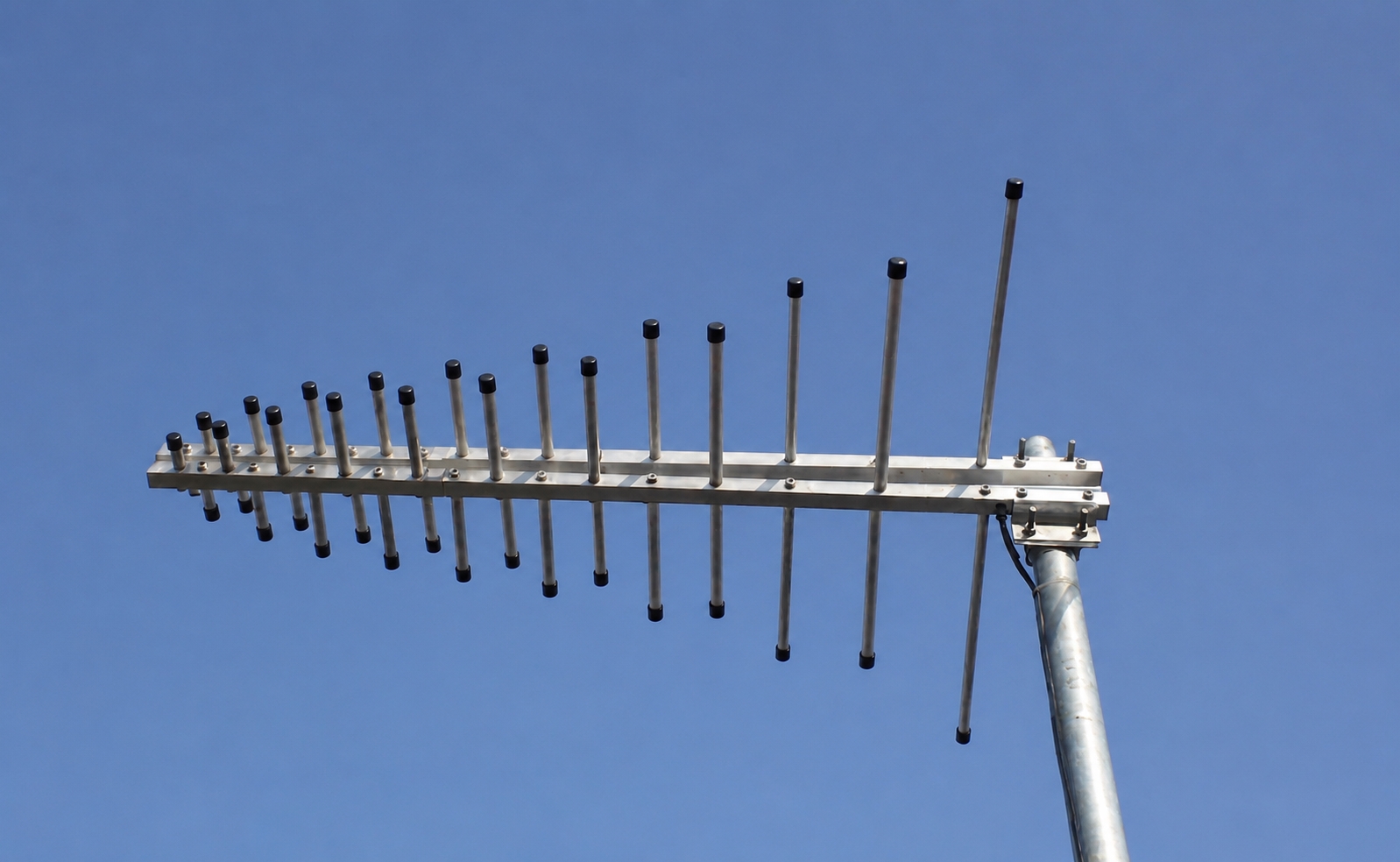

When a link has to work across many channels, or you do not know in advance which frequency you will need, a broadband antenna saves cost and complexity. Our log periodic antennas give directional gain over a wide bandwidth, from VHF through UHF and into the microwave range, using a single antenna and a single feed.
Choose by bandwidth first. Our broadband range includes models from the 20 MHz wide SLP-88108 for the FM band to the 6.5 GHz wide SLP-6177200 for microwave work.
Why broadband matters
- Fewer antennas on the mast: one log periodic replaces several narrowband antennas, which reduces wind load, mounting hardware and cabling.
- Frequency agility: change channel or band without changing the antenna.
- Directional gain across the band: 7 dBi to 20+ dBi, so range improves instead of dropping as you move off a single tuned frequency.
- Future-proof installations: if your frequency plan changes later, a wideband antenna can often stay in place [verify].
Typical broadband uses
- Multi-channel radio links: a single antenna serving several VHF or UHF channels from one site
- Wireless data and telemetry networks: point-to-point and point-to-multipoint links where the operating frequency may change
- Broadcast reception and link monitoring: receiving across the FM band and neighbouring bands (see SLP-88108)
- Lab and test benches: a wideband directional reference across a large span
- Research and field trials: testing different bands without swapping antennas
Broadband model guide
| Bandwidth | Example model | Notes |
|---|---|---|
| Narrow wideband (20 MHz) | SLP-88108 | 88 MHz to 108 MHz, FM band |
| Ultra wide (15 MHz to 3 GHz) | SLP-153000 | One antenna from HF through low microwave |
| Microwave broadband | SLP-6177200 | 617 MHz to 7200 MHz, 11 dBi |
| High gain with amplifier | SLPLNA-301000, SLPLNA-100500 | 20 dBi or more, for weak signals |
See the full model table for all 12 models.
Broadband trade-offs to know
A wideband antenna usually has lower peak gain at any one frequency than a narrowband antenna of the same size, such as a Yagi tuned to that frequency. If you need the highest gain at a single frequency, ask us about a Yagi antenna. If you need to cover many frequencies with one directional antenna, a log periodic is the right choice.
Accessories for a complete installation
Pair your antenna with mounting hardware and a gas discharge tube surge arrestor for lightning protection. Splitters and power dividers are also available.
Get a broadband antenna for your band
Send us your frequency range, gain target and mounting details. We can recommend a standard model or build a custom in-band or out-of-band version. Request a quote.
FAQs
How wide is the bandwidth of a log periodic antenna?
It depends on the model. SLP-88108 covers 20 MHz, while SLP-6177200 covers about 6.5 GHz.
Is a log periodic better than a Yagi?
For covering many frequencies, yes. For the highest gain at one frequency, a Yagi is usually better.
Can I get an amplified version?
Yes. The SLPLNA models include a low noise amplifier and are rated 20 dBi or more.
LOG PERIODIC ANTENNA :: Available Models
| # | Model | Frequency | Bandwidth | Gain | Datasheet | Enquiry |
|---|---|---|---|---|---|---|
| 1 | SLP-153000 | 15-3000 MHz | 2985 | 12 dBi. | 📄 | @ |
| 2 | SLPLNA-301000 | 30-1000 MHz | 970 MHz | ≥ 20 dBi. | 📄 | @ |
| 3 | SLP-301000 | 30-1000 MHz | 970 | 9 dBi | 📄 | @ |
| 4 | SLP-302000 | 30-2000 MHz | 1970 | 7 dBi. | 📄 | @ |
| 5 | SLP-050500 | 50-500 MHz | 450 | 7 dBi. | 📄 | @ |
| 6 | SLP-5015 | 50-1500 MHz | 1450 | 7 dBi. | 📄 | @ |
| 7 | SLP-88108 | 88-108 MHz | 20 | 7 dBi. | 📄 | @ |
| 8 | SLP-901100 | 90 - 1100 MHz | 1010 | 7 dBi. | 📄 | @ |
| 9 | SLPLNA-100500 | 100-500 MHz | ≥ 20 dBi. | ≥ 20 dBi. | 📄 | @ |
| 10 | SLP-40015 | 400-1500 MHz | 1100 | 7 dBi. | 📄 | @ |
| 11 | SLP-6177200 | 617-7200 MHz | 6583 | 11 dBi | 📄 | @ |
| 12 | SLP-7003000 | 700-3000 MHz | 2300 | 9 dBi. | 📄 | @ |
Disclaimer
1. All features, functionality and product specifications are subject to change without prior notice
2. Customized in-band and out-of-band versions are available on request