

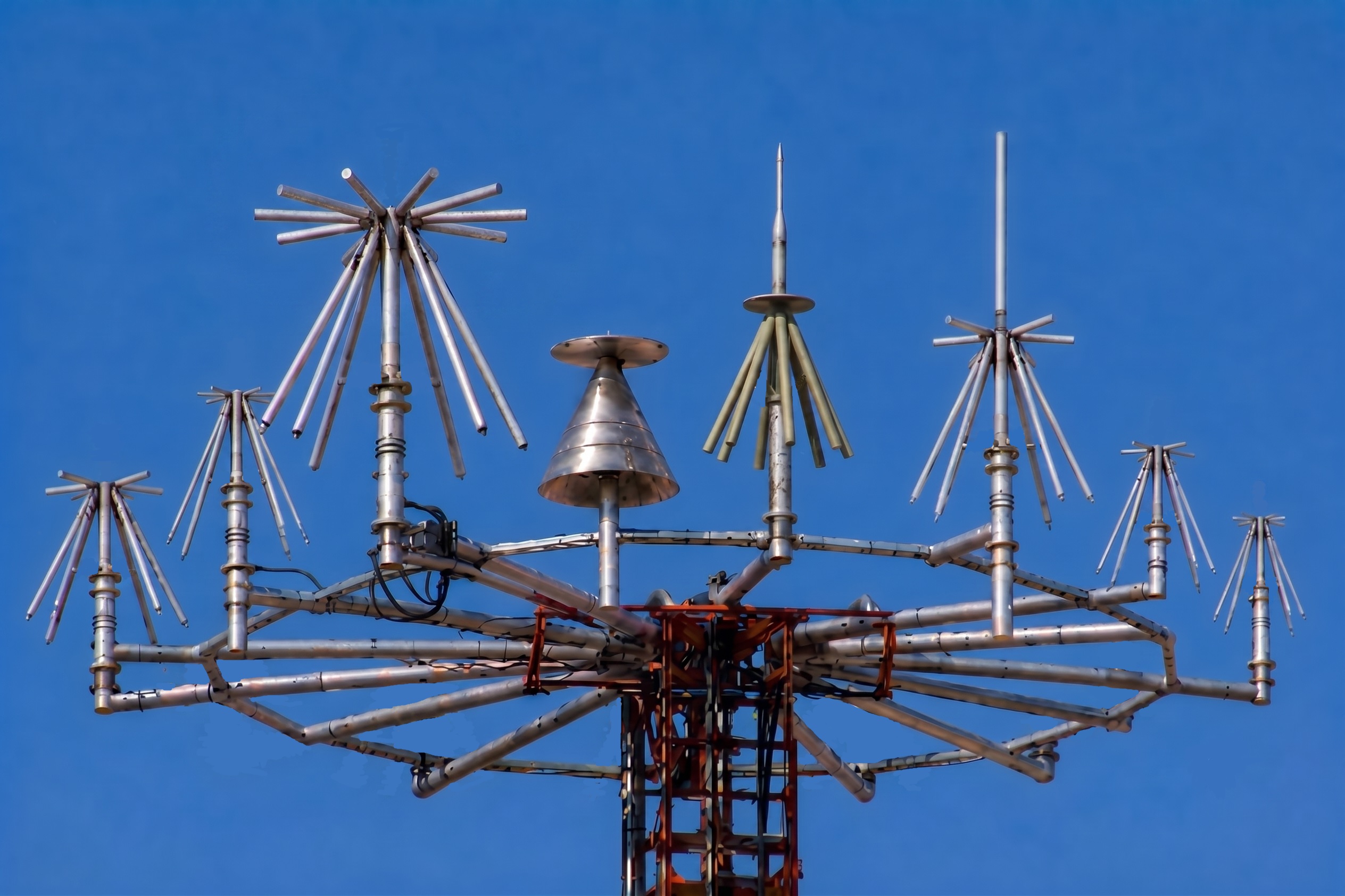
A discone antenna is an omnidirectional, ultra-wideband antenna that can transmit and receive across a very large frequency range with no tuning. If you need to listen or communicate on many frequencies from one site, and you do not know in advance which direction the signal will come from, a discone is often the simplest answer.
In this guide we explain how a discone antenna works, what makes it different from other antennas, where it is used, and how to choose the right model for your frequency range.
How Does A Discone Antenna Work?
The name describes the shape: a flat disc mounted above a cone. The disc sits on top and the cone opens downward. The two together form a wide-band radiator with an omnidirectional pattern in the horizontal plane, which means it covers 360 degrees around the antenna.
Most antennas work best at one frequency, set by the length of their elements. A discone has no single resonant length, so it keeps a usable match across a much wider band. That is why one discone can replace several narrowband antennas at a site.
Key Features of a Discone Antenna
- Ultra-wideband coverage. Our discone antennas cover 30 MHz up to 6 GHz across five models.
- Omnidirectional pattern. It receives and transmits in all horizontal directions, so you do not need to point it or add a rotator.
- Unity gain. A discone does not focus the signal in one direction. This gives broad coverage rather than long-distance directional range.
- No field tuning. It needs no adjustment after installation.
- Rugged, all-weather build. Our models use 6.5 mm thick disc and cone elements in chrome-plated brass or aluminium, and the termination and feed cable are enclosed inside the mounting pipe for weather protection.
- Easy to ship and install. The cone and disc are removed for packing and fitted on site, and mounting hardware makes installation quick.
Where Are Discone Antennas Used?
Because they cover so many frequencies in all directions, discone antennas are used wherever flexibility matters more than directional range:
- Base stations: broadband transmit and receive from a fixed site.
- Signal monitoring and surveillance: scanning wide bands with a receiver or spectrum analyser, and finding out which frequencies are active. See our discone antennas for monitoring and surveillance.
- Defence and military communication: wideband antennas for base stations, command posts and temporary sites. See our discone antennas for defence use.
- Testing and measurement: a wideband omnidirectional reference antenna in labs and field trials.
- Multi-radio sites: one antenna serving several bands, which reduces clutter on the mast.
How to Choose a Discone Antenna
Three checks cover most decisions.
- Frequency range. This is the most important choice. The antenna must cover every frequency you need, so list your bands first.
- Bandwidth. A wider range gives you flexibility, but a model made for your exact band can suit that band better. Our 330 to 550 MHz model, for example, has a VSWR of 1:1.5 across that UHF band.
- Site and mounting. Think about weather exposure, the pipe or mast you will fit it to, and whether you need to move it between sites.
Here are our five discone models:
| Model | Frequency range | Bandwidth | Gain |
| SOD-30100 | 30 to 100 MHz | 70 MHz | Unity |
| SOD-100700 | 100 to 700 MHz | 600 MHz | Unity |
| SOD-3201800 | 320 to 1800 MHz | 1480 MHz | Unity |
| SOD-330550 | 330 to 550 MHz | 220 MHz | Unity |
| SOD-7006000 | 700 to 6000 MHz | 5300 MHz | Unity |
If your band is not covered, we can supply custom in-band and out-of-band versions. See the full range on our discone antenna page.
Limits of a Discone Antenna
A discone is not the right antenna for every job. Because it has unity gain and covers all directions, it will not reach as far in one direction as a directional antenna.
- If you need directional gain across a wide band, use a log periodic dipole antenna.
- If you need the most gain at a single frequency, use a Yagi antenna.
- If you need all-round coverage across many frequencies, a discone is the right choice.
Many sites use a discone to find and monitor signals, then add a directional antenna for the links that matter.
Installation Tips
- Mount the antenna high and clear of metal obstructions.
- Use low-loss cable, especially at higher frequencies.
- Protect the installation from lightning with a gas discharge tube surge arrestor.
- Use proper mounting hardware, or a portable mast for temporary sites.
Frequently Asked Questions
- What frequency range does a discone antenna cover?
That depends on the model. Our five discone models together cover 30 MHz to 6 GHz. - Does a discone antenna need tuning?
No. It needs no field tuning or adjustment. - Is a discone antenna directional?
No. It is omnidirectional and receives signals from all horizontal directions. - What is the gain of a discone antenna?
Our discone antennas are unity gain. - Can I use a discone antenna for both transmitting and receiving?
Yes. It can be used for both.
Need a Discone Antenna For Your Site?
STAR Antenna has designed and built RF antennas since 1990, and we supply custom in-band and out-of-band versions on request. Tell us your frequency range, mounting and environment, and our engineers will recommend a model. Request a quote or ask for a datasheet.