
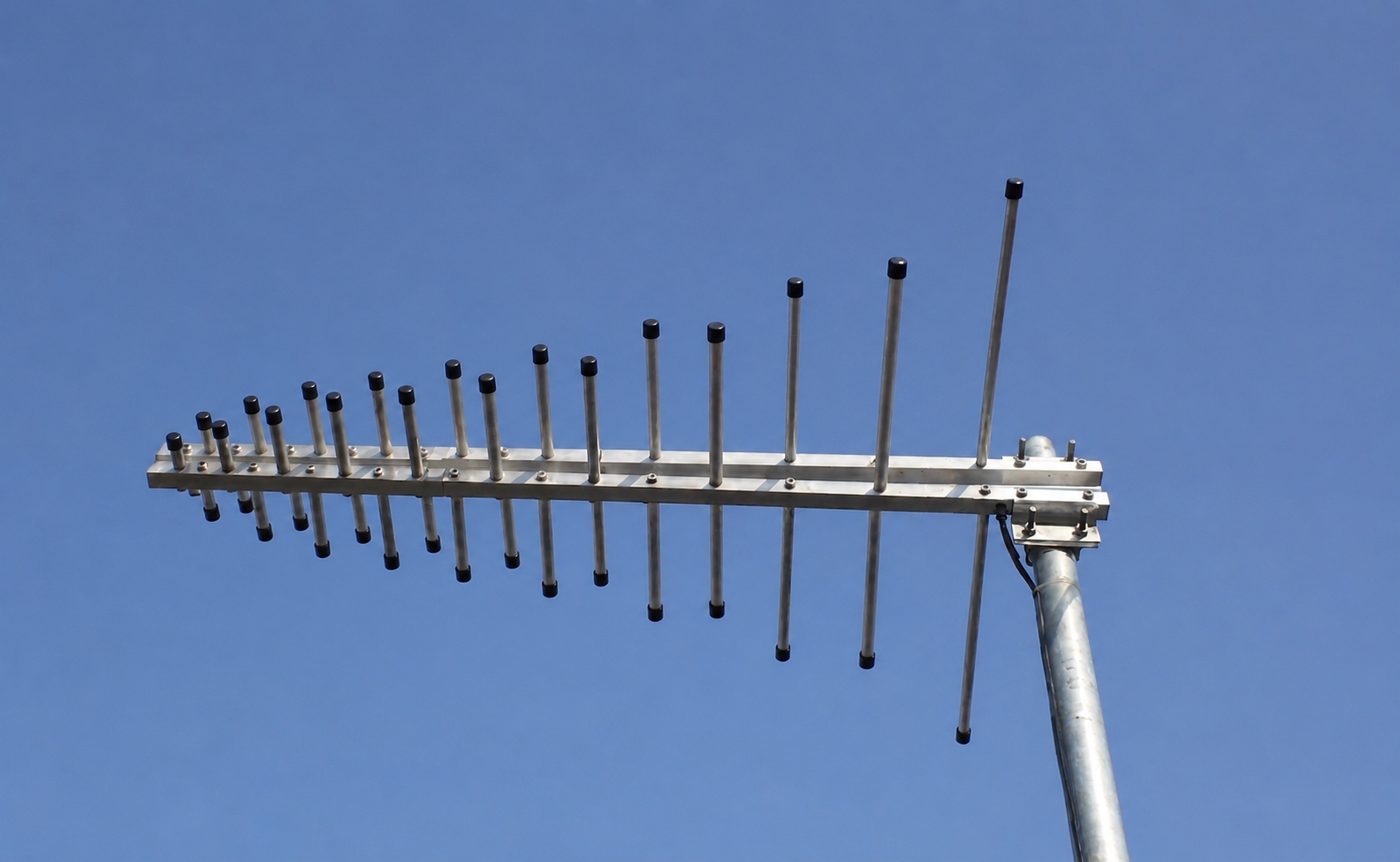
A log periodic dipole antenna (LPDA) is a directional antenna that gives steady gain across a very wide range of frequencies. If you need to point at a signal source but cannot limit yourself to one channel, an LPDA does what a Yagi cannot: it keeps its directional pattern across a whole band.
In this guide we explain how a log periodic dipole antenna works, what makes it different from other antennas, where it is used, and how to choose the right one.
How does a log periodic dipole antenna work?
An LPDA is built from a row of dipole elements mounted along a boom. The elements get progressively shorter from the back of the antenna to the front, and their spacing follows a repeating (logarithmic) pattern. That pattern gives the antenna its name.
At any one frequency, the elements that are close to half a wavelength long do most of the work. This is called the active region. As the frequency goes up, the active region moves toward the shorter elements at the front. As it goes down, it moves toward the longer elements at the back. Because the antenna always has a suitable set of elements to use, its gain and pattern stay steady across a wide band.
Key features of a log periodic dipole antenna
- Wideband directional gain. Our LPDA models give 7 dBi to 20+ dBi, depending on the model, from VHF through UHF and into the microwave bands.
- Very wide coverage. Across our 12 models, coverage runs from 15 MHz up to 7.2 GHz. Each model covers its own band, from a 20 MHz wide FM band model to a microwave model about 6.5 GHz wide.
- Steady pattern across the band. One antenna keeps its directional behaviour as you change frequency, which helps when you scan, test or monitor.
- Amplified versions. Our SLPLNA models include a low noise amplifier and are rated 20 dBi or more, for weak or distant signals.
- Durable hardware. All screws, nuts and bolts are stainless steel.
- Custom versions. In-band and out-of-band versions are available on request.
Where are log periodic dipole antennas used?
- Broadband and multi-channel links: one directional antenna serving several channels or bands. See our broadband log periodic antennas.
- Defence and military communication: wideband directional links between sites. See our log periodic antennas for defence use.
- Monitoring and surveillance: pointing at a source across a wide band, with LNA models for weak signals. See our log periodic antennas for monitoring.
- Testing and measurement: a wideband directional reference antenna, including EMC pre-compliance work.
- Research and field trials: trying different bands without swapping antennas.
LPDA vs Yagi vs discone antenna
The three antennas solve different problems. This table shows the main differences.
| Log periodic dipole | Yagi | Discone | |
| Pattern | Directional | Directional | Omnidirectional |
| Bandwidth | Very wide | Narrow | Very wide |
| Gain | 7 to 20+ dBi in our models | 10 to 16 dBi in our standard and dual stacked models | Unity |
| Best for | Directional links across many frequencies | Highest gain at one band | All-direction coverage across many frequencies |
Read more about our Yagi antennas and discone antennas.
How to choose a log periodic dipole antenna
- Frequency range. List every frequency you need. The antenna must cover all of them. Models range from a 20 MHz wide FM band antenna to a microwave model that covers 617 MHz to 7200 MHz.
- Gain. Standard models give 7 dBi to 12 dBi. If you need to receive weak or distant signals, choose an LNA model rated 20 dBi or more.
- Polarization and connector. Check these against your radio and the antenna at the other end of the link, and ask us if you need a particular type.
- Mounting and site. Think about the mast or pipe, wind and weather exposure, and whether the antenna will be fixed or moved between sites.
- Custom needs. If your band is not covered, we can build a custom in-band or out-of-band version.
See all 12 models on our log periodic dipole antenna page.
Limits of a log periodic dipole antenna
- Lower gain at a single frequency. A wideband antenna usually gives less gain at one frequency than a Yagi tuned to it. If you need the most gain at one band, use a Yagi antenna.
- Antennas for lower frequencies are larger. Longer elements are needed as the frequency goes down, so plan your mast and mounting for the size of the model.
- It must be aimed. If you do not know where the signal comes from, or need all-round coverage, use a discone antenna.
Installation tips
- Point the antenna at the other site or source, with a clear path.
- Mount it high and away from metal objects that distort the pattern.
- Use low-loss cable, especially at higher frequencies.
- Protect the installation with a gas discharge tube surge arrestor.
- Use proper mounting hardware, or a portable mast for temporary sites.
Frequently asked questions
- What does LPDA stand for?
Log periodic dipole antenna. - What frequency range do log periodic dipole antennas cover?
Our 12 models together cover 15 MHz to 7.2 GHz. Each model covers its own band, so choose by the range you need. - What gain does a log periodic dipole antenna have?
Our models give 7 dBi to 20+ dBi, depending on the model. - Is a log periodic dipole antenna directional?
Yes. It focuses the signal in the direction the antenna points. - What is the difference between an LPDA and a Yagi?
A Yagi gives more gain to one band. An LPDA gives directional gain across a much wider band, usually with less gain at any single frequency. - What is the difference between an LPDA and a discone antenna?
A discone covers all directions at unity gain. An LPDA points in one direction and reaches further that way. - Can I get an LPDA with a built-in amplifier?
Yes. The SLPLNA models include a low noise amplifier and are rated 20 dBi or more. - Can one LPDA replace several antennas?
Within its frequency band, yes. One LPDA can cover a wide range that would otherwise need several narrowband antennas. - Can you make a custom log periodic antenna?
Yes. Custom in-band and out-of-band versions are available on request. - Do you supply log periodic antennas outside India?
Yes. We supply worldwide and support OEM, ODM and distributor orders.
Need a log periodic antenna for your project?
STAR Antenna has designed and built RF antennas since 1990. Tell us your frequency range, gain target and mounting, and our engineers will recommend a model or build a custom version. Request a quote or ask for a datasheet.